- Your cart is empty Browse Shop
Government Subsidy for Dragon Fruit Farming in Karnataka: 2026 Guide
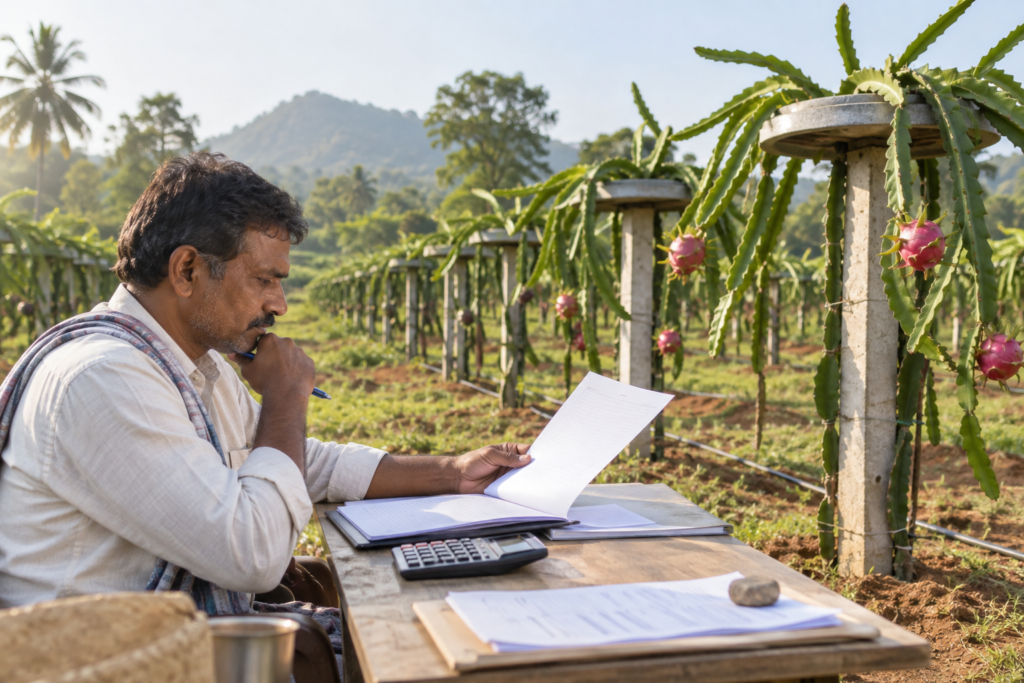
Government subsidy for dragon fruit farming may help eligible farmers establish a new plantation, but subsidy is not automatic and should never be treated as guaranteed income. Karnataka farmers must confirm the current scheme, district allocation, beneficiary category, application window and approved components before starting work or purchasing material.
This guide explains the current central cost norm, the approximate assistance calculation, documents and application precautions for farmers searching for exotic fruit farming subsidy in Karnataka. Scheme conditions and budgets can change, so verify every detail with the Karnataka Department of Horticulture before investing.
Is Subsidy Available for Dragon Fruit Farming?
Dragon fruit is included in the Mission for Integrated Development of Horticulture (MIDH) operational guidelines. The April 2025 MIDH guidelines list dragon fruit with a support system under new orchards and plantation crops. However, inclusion in national guidelines does not mean that every farmer will automatically receive assistance.
Implementation in Karnataka depends on the approved annual action plan, available budget, district targets, farmer eligibility, field verification and sanction by the competent authority. Applications can also be limited by category, location or the number of beneficiaries. Always obtain confirmation from the local horticulture office before beginning the project.
MIDH Cost Norm and Indicative Assistance
The official MIDH Operational Guidelines issued through the National Horticulture Board list a cost norm of ₹6.75 lakh per hectare for dragon fruit with a support system and assistance at 40% of the cost norm in general areas.
At the stated norm, 40% works out to a theoretical maximum of ₹2.70 lakh per hectare. One hectare is approximately 2.471 acres, so the cost norm is about ₹2.73 lakh per acre and 40% is about ₹1.09 lakh per acre. These acre figures are only mathematical conversions of the national norm, not a promise of payment.
The amount finally sanctioned may be lower and is subject to eligible area, approved components, actual verified expenditure, scheme ceiling, beneficiary contribution, inspection and fund availability. Land price, unrelated civil works, unapproved purchases and expenses incurred before approval may not qualify.
What the Cost Norm May Cover
Eligible items are determined by the scheme and sanction order. For dragon fruit, the approved project may consider planting material, field establishment and the required support system within prescribed norms. Irrigation, water structures, mechanisation or other components may fall under separate scheme heads and require separate eligibility and approval.
Do not assume that the subsidy percentage applies to the farmer’s total project bill. The calculation normally relates to the approved cost norm or eligible verified cost, subject to the lower amount and programme rules. Ask the department for a written component-wise explanation.
Who Should Check Eligibility?
- Individual farmers planning a new dragon fruit plantation.
- Eligible farmer groups, FPOs or institutions covered by the notified programme.
- Farmers with clear land possession and a suitable water source.
- Applicants able to contribute their share and maintain the plantation.
- Applicants who have not received overlapping assistance for the same component.
Eligibility can vary by scheme and year. Special-category requirements, minimum or maximum area, Aadhaar linkage, bank details and land-record conditions should be checked with the department. Tenant or leased-land applicants should obtain specific guidance before applying.
Documents Commonly Required
- Aadhaar and recent applicant photograph.
- RTC or other accepted land-possession records.
- Bank passbook and account details linked to the applicant.
- Farmer registration or FRUITS identification, where required.
- Quotation, project estimate and proposed field layout.
- Water-source and irrigation details.
- Planting-material and support-system specifications.
- Caste or category certificate where applicable.
- Mobile number and other declarations requested by the department.
The exact document list may differ by district and component. Use current records and ensure that the applicant name is consistent across Aadhaar, land and bank documents. Retain copies of the submitted application, acknowledgement, quotations, invoices, photographs and inspection records.
Application Process in Karnataka
- Visit the taluk or district horticulture office before spending money.
- Ask whether dragon fruit assistance is open under the current action plan.
- Confirm eligibility, area limits, cost norms and application dates.
- Submit the prescribed application and supporting documents.
- Obtain acknowledgement and wait for field verification or approval.
- Start only the work permitted by the written sanction or departmental instruction.
- Buy approved planting material and maintain valid invoices and payment proof.
- Complete the plantation according to the approved specifications.
- Cooperate with inspections and submit completion documents.
- Track the claim and correct any documented deficiency promptly.
Farmers should use the Karnataka Department of Horticulture portal and the local horticulture office for current notifications. Portal availability alone should not be treated as approval.
Common Reasons for Delay or Rejection
- Starting plantation work before required approval or inspection.
- Incomplete, outdated or mismatched applicant documents.
- Purchasing unverified planting material without proper invoices.
- Plant density or support structure not matching approved specifications.
- Claiming an ineligible component or duplicate subsidy.
- Missing geo-tagged photographs, inspection or payment evidence.
- Application submitted after the target or budget is exhausted.
Plan the Farm Even Without Subsidy
A financially viable project should not depend entirely on subsidy. Prepare the complete investment, maintenance and marketing plan based on your farm conditions. Subsidy is generally released only after compliance and verification, so farmers may need sufficient funds to complete approved work first.
Before investing, read our guides on exotic fruit planting material in Karnataka and the dragon fruit market and buyers in Bengaluru.
Frequently Asked Questions
How much subsidy is available for dragon fruit farming?
The April 2025 MIDH norm lists assistance at 40% of the ₹6.75 lakh per-hectare cost norm for dragon fruit with support in general areas. Actual Karnataka sanction is subject to current implementation, eligibility, approved cost, inspection and budget.
Can a farmer plant first and apply later?
Do not assume this is allowed. Many assistance programmes require application, verification or approval before work begins. Obtain written guidance from the local horticulture office first.
Does KEFA guarantee subsidy approval?
No. KEFA can support awareness, networking and farm planning, but only the authorised government department can determine eligibility, sanction assistance and release funds.
Contact KEFA
Contact Karnataka Exotic Fruit Farmers Association for farmer networking, planting guidance, training and exotic fruit farm consultation. For subsidy approval and the latest application procedure, contact the authorised Karnataka horticulture office directly.